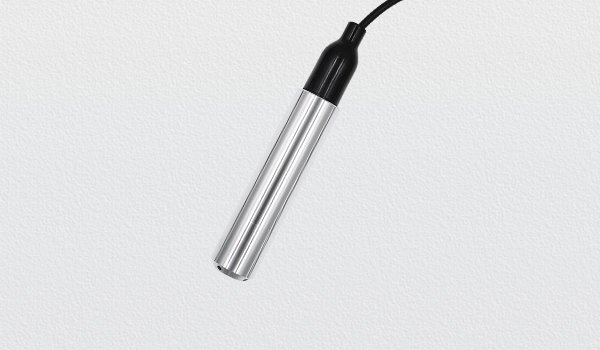
Main Principles and Features of the Hydrostatic (Submersible) Level Sensor
Publication date:2026-10-13 00:18
The hydrostatic (submersible) level sensor is a liquid level measuring instrument based on the principle of hydrostatic pressure, with mature technology, easy installation and high cost performance. It performs excellently in occasions with static liquid, normal pressure and stable medium density, and is especially suitable for measurement with a large range and deep liquid level. However, in use, special attention must be paid to changes in medium density and to maintenance of the vent cable.
I. Working Principle
The core principle of the hydrostatic level sensor is the principle of hydrostatics, i.e. the static pressure at a point in a liquid is proportional to the height from that point to the liquid surface and to the density of the liquid. Its basic working formula is: P = ρ × g × h
Where:
P: the static pressure at the bottom of the liquid or at a certain point (unit: Pa)
ρ: the density of the liquid (unit: kg/m³)
g: gravitational acceleration (about 9.8 m/s²)
h: liquid level height (unit: m)
By measuring the static pressure P at the bottom of the liquid or at a certain depth, and given the known liquid density ρ and gravitational acceleration g, the liquid level height h can be accurately calculated.
Reference pressure handling:
Gauge pressure measurement (Gauge Pressure): this is the most common method. Inside the sensor there is a vent cable that guides the atmospheric pressure P_atm to the back (reference end) of the pressure-sensitive element. In this way, what the element actually measures is the difference between the static pressure and the atmospheric pressure, i.e. P = P_liquid column + P_atm - P_atm = ρgh. This method eliminates the influence of atmospheric pressure changes on the measurement, directly obtaining the pressure generated by the liquid column height.
Signal conversion and output: The pressure-sensitive element converts the pressure signal into a weak electrical signal, which is processed by the amplifier, temperature compensation circuit, etc. inside the sensor, and finally outputs a standard 4-20mA current signal, 0-5/10V voltage signal or digital signal (such as RS485, HART) that is linearly related to the liquid level height.
II. Main Features
Simple installation, no equipment modification needed: simply submerge the sensor at the bottom of the liquid and secure it. There is no need to drill holes in the tank body or install flanges (except in special cases), making it especially suitable for the modification and installation of existing containers.
Wide measurement range: water depths from a few meters to over a hundred meters can be measured, making it very suitable for large-range occasions such as deep wells, reservoirs and large storage tanks.
High accuracy and high stability: the core pressure sensor body technology is mature, with accuracy up to 0.1%, 0.25%FS, etc., and good long-term stability.
Maintenance-free: the sensor has a simple structure and no moving parts; the parts in contact with the medium are usually made of stainless steel or ceramics, which are corrosion-resistant and highly reliable, requiring basically no maintenance.
Wide range of applicable media: it can measure many liquids such as water, oil, acid, alkali and sewage; you only need to choose the appropriate probe material (such as 316 stainless steel, Hastelloy, ceramics, etc.) according to the corrosiveness of the medium.
Relatively moderate price: compared with non-contact instruments such as radar and ultrasonic, the hydrostatic level gauge has high cost performance.