How to Wire a Pressure Transmitter?
Publication date:2026-10-13 00:18
How is a pressure transmitter wired? The wiring method of a pressure transmitter mainly depends on its power supply type (two-wire, three-wire, four-wire) and its output signal type (analog 4-20mA, 0-5v/0-10v, digital protocol, etc.). At present, the most widely used type in the field of industrial automation is the two-wire 4-20mA transmitter.
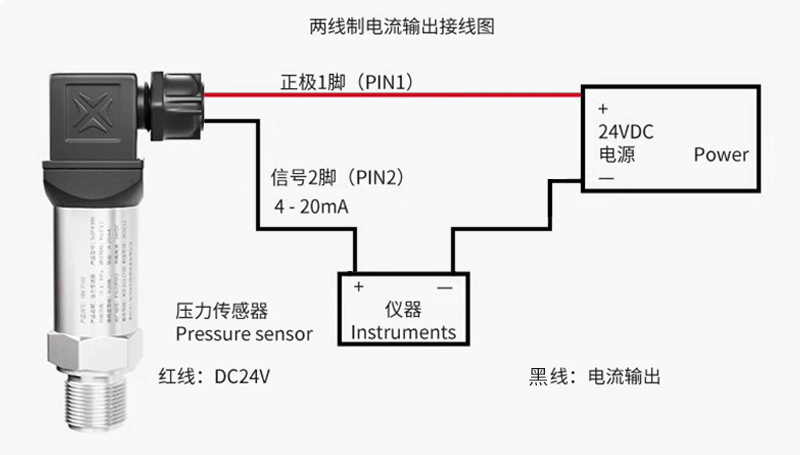
1. Two-wire system (4-20mA output)
Wiring analysis: The red wire (or marked +) connects to the positive pole of the power supply (+24V); the black wire (or marked -) connects to the positive current input terminal of the signal receiving device (such as the AI module of a PLC). The negative current input terminal (or common terminal COM) of the signal receiving device connects back to the negative pole of the power supply (0V).
Working mode: The internal circuit of the transmitter adjusts its own impedance, so that the loop current varies between 4mA (corresponding to zero pressure/lower limit of the range) and 20mA (corresponding to full-scale pressure). The power supply powers the entire transmitter through the signal line.
Advantages: strong anti-interference capability (current signal), simple wiring (only two wires needed), capable of long-distance transmission, and intrinsic safety design is easier to achieve.
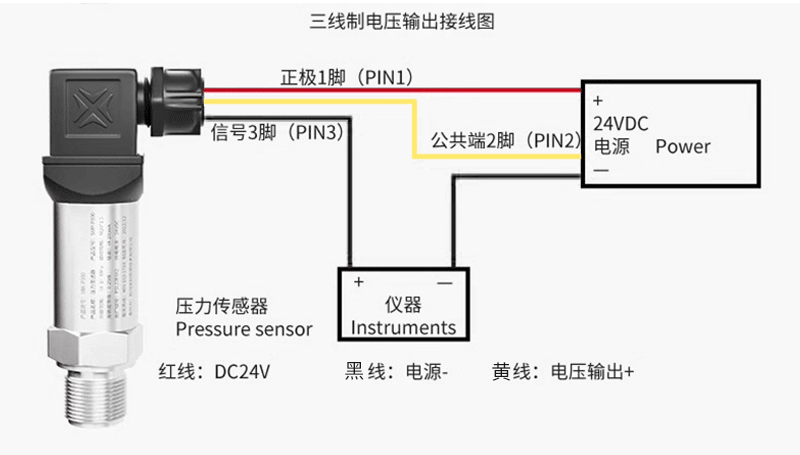
2. Three-wire system (voltage output type, such as 0-5V, 0-10V, 1-5V)
Three wires: power positive (+Vcc, usually +12V~+24V DC), power negative (GND), and signal output (Vout+).
Signal ground: The ground (reference point) of the output signal is usually connected to the power ground (GND) inside the sensor.
Wiring: The red wire (or marked +V) connects to the positive pole of the power supply, and the black wire (or marked GND) connects to the negative pole of the power supply and the common ground (COM) of the signal receiving device. The green/blue/white wire (or marked OUT/Sig) connects to the positive analog input terminal of the signal receiving device (the negative input terminal of the signal receiving device is also usually connected to COM/GND).
Disadvantages: The transmission distance of voltage signals is limited, and they are easily affected by line voltage drop and interference.