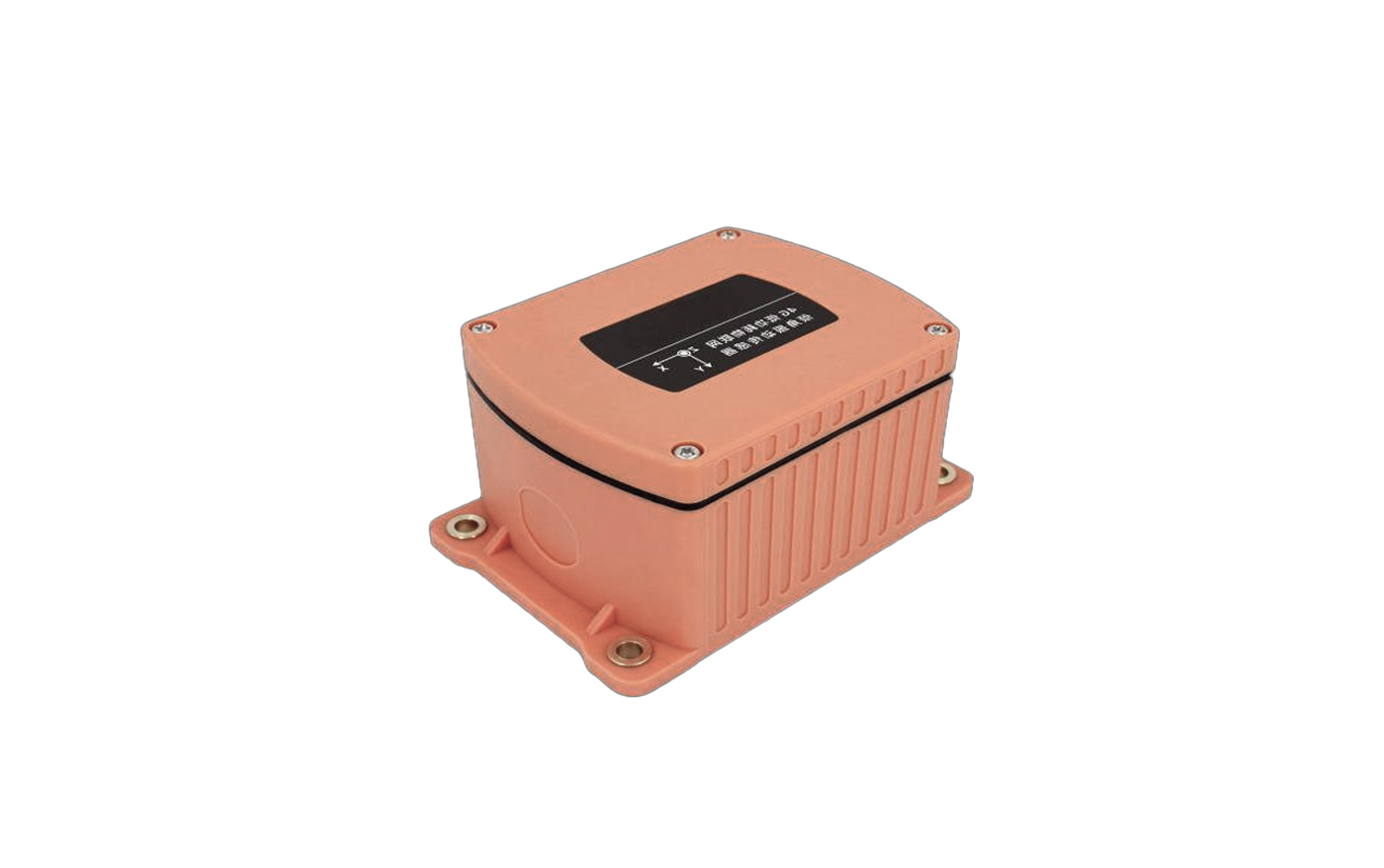
| Product Overview
The WCIS410-6 series wireless NB-IoT tilt sensor is a product independently developed by Winchen for triaxial attitude measurement. It offers low cost, low power consumption, wide network coverage and remote monitoring, solving the problem for industries that have no outdoor power supply or do not need continuous measurement but must periodically check the tilt angle of objects. Equipped with a large-capacity 19AH lithium thionyl chloride battery, it can report data to the relevant platform at scheduled times according to the wake-up interval set by the user; through the network service platform, users can know the status of the measured object without going on site. Scheduled reporting and over-threshold alarm modes are provided: when a user sets an angle threshold and the product detects that the object suddenly exceeds it, the device is actively woken and reports the information immediately; when a user sets an acceleration threshold and the product detects that the object's sudden acceleration exceeds the set value, the device is actively woken and reports the alarm information at once.
| Features
1. Triaxial tilt measurement: It supports omnidirectional attitude sensing in 3D space along the X, Y and Z axes, monitoring not only single-axis tilt but also effectively identifying multi-dimensional angle changes under complex conditions, eliminating the measurement blind spots of single-axis sensors when the installation direction is limited;
2. High accuracy and high resolution: Accuracy up to 0.1°, resolution of 0.05°;
3. Narrowband IoT private network: Built on the NB-IoT (Narrowband Internet of Things) cellular network, it offers wide coverage, deep penetration (about 20dB higher than 2G/3G) and massive connectivity (a single sector supports 50,000+ nodes). Compared with Wi-Fi/Bluetooth, no on-site gateway configuration is needed; compared with 4G, the module costs less and has stronger signal penetration;
4. Extremely low static power consumption: Standby power consumption as low as 60μA, with negligible current draw when not woken, greatly extending the overall replacement cycle;
5. Extra-large-capacity primary battery: Built-in 19AH lithium thionyl chloride battery with an extremely low annual self-discharge rate (<1%);
6. Active edge alarms: Supports user-defined alarm thresholds. The decision logic runs on the device itself, so when the angle exceeds the limit the sensor proactively pushes an alarm to the platform instead of passively waiting for the platform to poll;
| Technical Specifications
|
Measuring range |
±90°(customizable) |
Measuring axes |
X, Y and Z axes |
|
Accuracy |
0.1° (<±15°); 0.5°>±15° |
Resolution |
0.05 |
|
Acceleration range |
±2g |
Zero bias error |
<0.002g |
|
Non-linearity |
<0.2%FS |
Cross-axis sensitivity |
1%FS |
|
Zero-point temperature coefficient |
0.008°/℃ |
Wireless communication standard |
LTE Cat1 |
|
Frequency band |
LTE-FDD: B1/B3/B5/B8; LTE-TDD: B34/B38/B39/B40/B41 |
Supported protocols |
TCP, UDP, MQTT |
|
Insulation resistance |
≥100 MΩ |
Shock resistance |
10g@11ms, three axes (half sine wave) |
|
Vibration resistance |
10grms, 10~1000Hz |
Waterproof rating |
IP67 |
|
Response bandwidth |
20HZ |
Electromagnetic compatibility |
Compliant with EN61000 and GB/T17626 |
|
Power supply |
19AH lithium thionyl chloride battery |
Supply voltage |
3.8V DC |
|
Operating current |
80mA (standard mode) |
Data transmission current |
2mA |
|
Standby current |
80mA |
Operating temperature |
-20-70℃ |
|
Storage temperature |
-20-70℃ |
Mean time between failures (MTBF) |
≥98,000 hours |
| Application Scenarios
1. Structural health monitoring
Bridge structural health monitoring: monitoring bridge tower inclination, pier settlement and girder deflection. Distributed deployment can identify millimeter-level displacement.
Historic building protection monitoring: real-time deformation monitoring of old, structurally fragile historic buildings; 0.1°accuracy is enough to capture the tiny tilts caused by uneven foundation settlement.
Dilapidated housing monitoring: monitoring foundation settlement and wall tilt deformation in old houses, giving early warning of collapse risks.
Dam/reservoir monitoring: monitoring dam body tilt and horizontal displacement.
Tunnel/culvert monitoring: monitoring the deformation of metro shield tunnels and railway tunnel structures.
2. Infrastructure and energy facility monitoring
Power transmission/communication tower monitoring: monitoring the tilt and settlement of transmission towers and communication towers.
Tower/tall structure monitoring: tilt monitoring of wind turbine towers, TV towers, chimneys and other tall structures.
Slope/retaining wall monitoring: monitoring slope stability and retaining wall tilt along highways and railways.
3. Urban safety and municipal management
Billboard/outdoor facility monitoring: monitoring the tilt of large billboards, light boxes and other outdoor facilities to prevent falling risks.
High-rise building monitoring: monitoring tilt changes in super high-rise buildings under wind loads, foundation settlement and other factors.
4. Industrial and storage facilities
Smart warehouse rack monitoring: deployed at the top of rack uprights or at key load-bearing points to monitor tilt caused by loads, forklift collisions or foundation settlement.
Industrial equipment condition monitoring: used for tilt compensation in weighing systems and level monitoring of large equipment platforms.
5. Geological disasters and disaster prevention and mitigation
Landslide/collapse displacement monitoring: deployed in high-risk landslide areas to monitor surface slip and tilt deformation. It can be integrated with GNSS displacement monitoring, image recognition and other technologies to build a comprehensive emergency monitoring system.
Foundation pit inclinometer monitoring: monitoring sidewall deformation during building foundation pit excavation.
6. Transportation and rail engineering
High-speed rail substructure monitoring: monitoring the settlement and tilt of high-speed rail bridge piers and roadbeds.
Rail transit monitoring: monitoring tunnel structures and pier tilt in metro and rapid transit systems.
Railway track monitoring: monitoring changes in rail attitude and reporting immediately when abnormal.