| Application Challenges
In traditional terminal crimping processes, the management and control of crimping quality has long faced many challenges. These problems not only affect product yield but also restrict the digital upgrade of production management.
1. Indirect measurement, poor accuracy: Traditional methods usually judge the crimping force indirectly by monitoring motor current or air pressure. This approach is highly susceptible to interference from equipment wear, voltage fluctuations and temperature changes, and its accuracy and reliability are hard to guarantee;
2. No real-time monitoring: Under the traditional mode, only destructive pull tests can be carried out on samples after crimping is completed, and 100% real-time monitoring of every crimp point is impossible;
3. Lack of process data: Traditional terminal machines have no force-displacement curve data for the crimping process. When a defect occurs, it is difficult to trace the root cause——was it a terminal problem, a wire problem or an equipment problem?
4. Parameter settings rely on experience: The setting of key parameters such as pressure and depth depends heavily on the operator's personal experience, making standardization and continuous optimization difficult;
5. No traceability: Traditional production cannot provide a complete quality data report for every crimp, which does not meet the strict requirements of industries such as automotive and aerospace for process data traceability.
| Solution
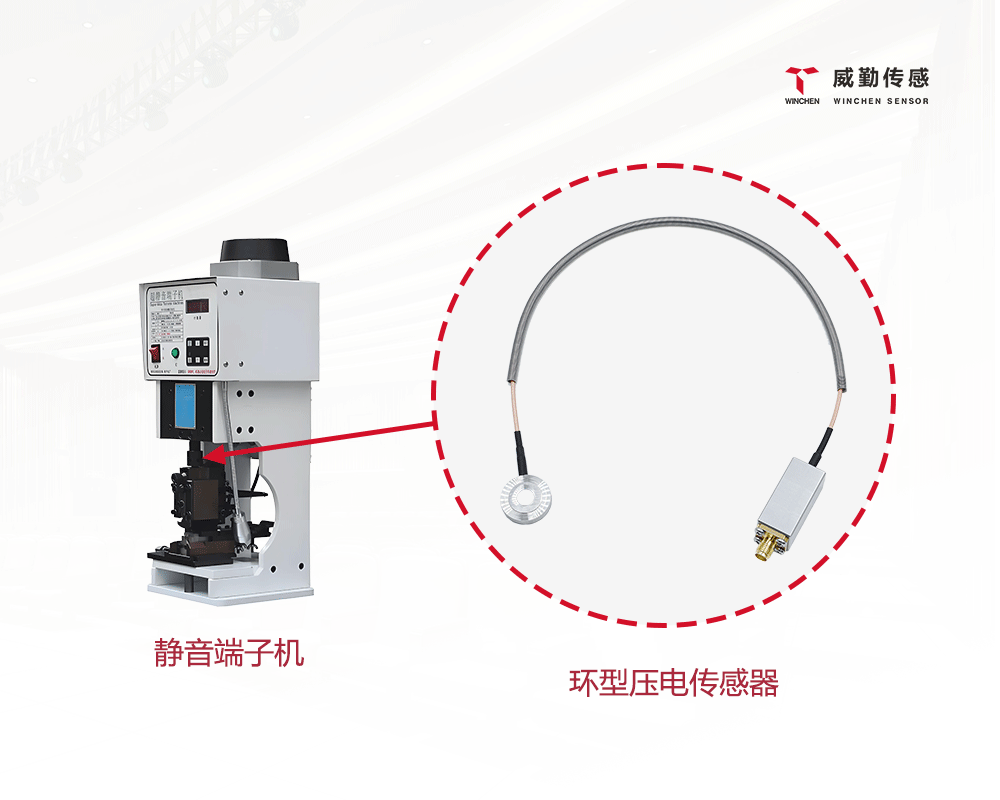
In response to the above, winchen sensor has launched a complete solution centered on a ring piezoelectric sensor, with a proximity switch sensor and a crimping force management device working together.
1. Ring piezoelectric sensor: Its working principle is based on the properties of piezoelectric quartz crystal material: when the crystal is subjected to mechanical stress, an internal charge proportional to the stress is generated. The ring sensor is installed in the force transmission path between the crimping die (blade die) and the slider of the terminal machine. When the press head moves down to crimp, all the pressure acting on the die passes through the ring sensor, producing a high-accuracy electrical signal strictly proportional to the real-time crimping force;
2. Proximity switch sensor: plays an indispensable auxiliary role in the solution. By detecting the terminal position and crimping state in real time, the proximity switch can effectively prevent abnormalities such as idle striking and misalignment, and can also accurately count production quantities, providing basic data support for production management;
3. Crimping force management device: responsible for high-speed acquisition and processing of the standard pulse signal from the ring piezoelectric sensor. Its core working mechanism is: first collect a certain number of good-product waveforms to generate a reference waveform, then compare the waveform collected in real time during production (the measured waveform) with the reference waveform. If the difference between the two exceeds a preset threshold, the device immediately outputs an alarm signal, prompting the operator to check product quality. The device can connect to visual systems, host computer systems and various other platforms, and works with an industrial computer/PLC and HMI running crimping management software to achieve real-time data processing, analysis, judgment, display and storage;
| Benefits and Results
1. Achieve 100% full inspection and prevent defective products from escaping: Through the cooperation of the ring piezoelectric sensor and the crimping force management device, the system can monitor and judge every crimp in real time. Once an abnormality is found it immediately stops and alarms, preventing nonconforming products from continuing to be produced and avoiding batch quality accidents;
2. From “experience-driven” upgraded to “data-driven”: The system fully records the force-displacement curve data of every crimp, transforming parameter settings that previously relied on operator experience into optimal parameter decisions based on massive data. Through the collection and analysis of crimping data, enterprises can gain an in-depth understanding of equipment operating conditions, summarize the best crimping parameters and achieve continuous optimization of the production process;
3. Achieve full-process traceability: The system generates a complete quality data report for every crimp point, meeting the strict requirements of high-end industries such as automotive and aerospace for process data traceability. When a quality problem occurs, the specific crimping time, equipment, parameters and waveform data can be quickly traced to pinpoint the root cause.
4. Improve production efficiency and equipment utilization: The system collects and analyzes crimping force values and alarms instantly on the production line kanban when abnormalities occur. This efficient online monitoring greatly reduces the time cost of manual sampling and destructive testing, and by providing early warning it avoids batch scrapping caused by running equipment with hidden faults.
5. Empower intelligent manufacturing and digital transformation: It provides complete data acquisition, analysis and traceability capabilities for the terminal crimping process, and is key data support for intelligent manufacturing and digital twin applications. By connecting crimping data to the enterprise MES system or host computer platform, enterprises can achieve digital management and control of the entire production process.