Dam Health Monitoring Solution - Dam Deformation Monitoring_Inclinometer
Publication date:2026-10-13 00:18
Dam Health Monitoring Solution——Dam deformation monitoring. Because the planning and construction cycle of a dam is very complex and many factors must be considered, such as permeability, the surrounding rock or soil, the frequency of earthquakes, and whether landslides, avalanches and other natural disasters frequently occur, inclinometers have been widely used for dam deformation monitoring. Some of them are installed directly on the dam body itself, while others are installed in the dam or in the foundation structure, to monitor in real time the tiny changes in the dam and its surrounding environment, such as seepage in the dam body, serious corrosion of the surrounding rock, and the impact of earthquakes, landslides and avalanches on the nearby geological environment. Although the impact is sometimes very small, if the small impact is not dealt with in time it may produce serious consequences.
The WCIS300 series inclinometer independently developed and produced by winchen sensor not only meets the needs of most structural health deformation monitoring, but can also be used in special applications such as dam monitoring. It can record and display the angle changes of the dam structure in real time and transmit the deformation angle values to the control system, which can provide prompts and alarms so that dam staff can learn the alarm information in time and take corresponding measures.
II. Monitoring Content of the Slope Detection System
Because of the dam foundation, dam body and the gravity of the water stored upstream, uneven settlement deformation of the dam, rotational deformation of the foundation and dam body, and torsional deformation of the dam body caused by the horizontal pressure of the stored water and changes in external temperature may occur. If these deformations are too large they will seriously affect the stability and safety of the dam, so the vertical displacement and horizontal displacement of the dam and the tilt of the dam body must be monitored.
The magnitude and pattern of the above deformations during dam construction and operation are monitored, and the dam deformation trend is predicted and forecast based on the deformation amount, thereby ensuring the quality and safety of dam construction and operation. The content of reservoir dam deformation monitoring mainly includes horizontal displacement at the top and bottom of the dam and vertical displacement at the top and bottom of the dam, as well as detection of the dam slope:
1. Vertical Movement Tilt Detection
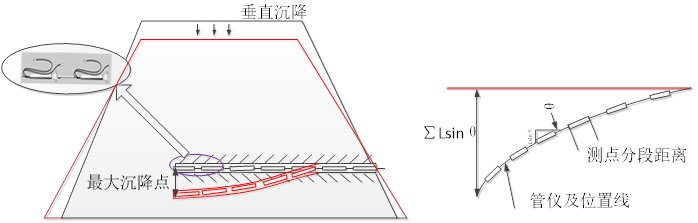
For the vertical displacement changes of monitoring points caused by the gravity of the dam foundation, dam body and upstream water body, inclinometers are placed through installed conduits; when the inclinometer detects a tilt change, the tilt angle of the horizontal node can be measured.
Inclinometers can be arranged as a single measuring unit working independently, or multiple units can be arranged in a chain to measure the tilt of each segment of the structure being measured, thereby describing the deformation curve of the structure. If installed in two dimensions on the target, the two-dimensional deformation of the structure can be measured. Inclinometers can be recovered and reused, making long-term dam health monitoring convenient.
2. Horizontal Movement Tilt Detection
Under the empty reservoir condition, a hydropower dam may tilt toward upstream due to the gravity of the dam body; after impoundment, it may tilt toward downstream due to the thrust of the reservoir water. The magnitude of this tilt greatly affects the stability of the dam body. By connecting the river-direction horizontal displacements of each elevation measuring point on the same vertical line into one line, the angle between this line and the vertical plane in the left-right bank direction is the vertical tilt angle of the dam body; by connecting the vertical displacements of each measuring point of the river-direction static level system in the dam foundation gallery into one line, the angle between this line and the horizontal plane is the horizontal tilt angle of the dam body.
3. Dam Body Slope Tilt Monitoring
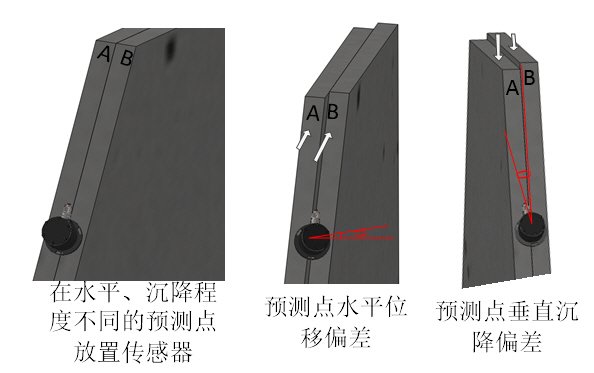
The slope tilt of a dam is affected jointly by vertical settlement and horizontal movement, producing a certain slope tilt. We monitor the slope tilt state with inclinometers, providing a reliable basis for analyzing the overall operation of the dam.
III. Building a Dam Attitude Monitoring System with winchen sensor WCIS300 Series Inclinometers
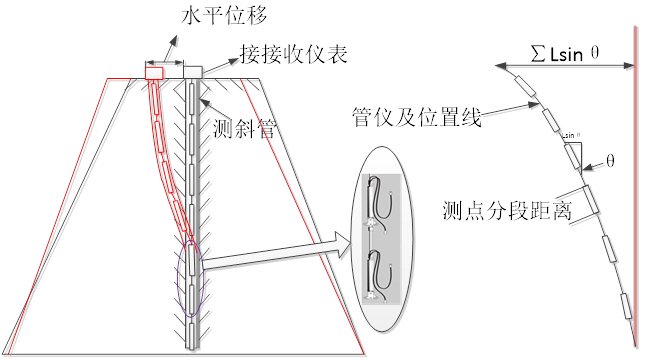
The overall dam system monitoring includes monitoring of the overall tilt attitude of the dam: horizontal displacement monitoring, vertical settlement monitoring and slope (dam face) tilt monitoring. Horizontal displacement monitoring uses fixed vertical sensors, placing a sensor string through vertical conduits in the dam body; vertical settlement uses fixed horizontal inclinometers, placing a sensor string in the horizontal direction of the dam body; slope monitoring uses WCIS300 series inclinometers placed at predicted tilt points.
A centralized data processing approach is adopted: the sensor strings are all connected to the data acquisition system, and after long-term data acquisition, alarms can be triggered based on a certain rate of change or other criteria. Through data analysis, the horizontal displacement and vertical settlement of the dam body within a certain period can be obtained, and combined with slope tilt analysis the current more detailed attitude of the dam can be determined.
1. Using WCIS300 Series Angle Sensors to Monitor Dam Horizontal Displacement
This includes a certain number of fixed inclinometers installed in inclinometer pipes. The inclinometer pipe provides a channel for below-ground measurement. The guide grooves inside the inclinometer pipe control the direction of the inclinometers; the inclinometer pipe is installed in a vertical borehole that passes through the region of the stratum where displacement movement may occur. One set of guide grooves must be aligned with the expected displacement direction.
For example, going down along the mountain or toward the excavated cavity, the inclinometers are fixed in the inclinometer pipe and span the displacement movement zone. When the stratum displaces, the inclinometer pipe displaces, causing the sensors installed in the pipe to tilt. Measuring the sensor tilt gives the displacement profile of the inclinometer pipe; the measurement length of each sensor shows displacement in millimeters, and the cumulative displacement of the whole sensor string is also shown in millimeters.
2. Using WCIS300 Series Angle Sensors to Monitor Dam Vertical Settlement
This includes a certain number of fixed inclinometers installed in inclinometer pipes. The inclinometer pipe provides a channel for below-ground measurement. The guide grooves inside the inclinometer pipe control the direction of the sensors. The inclinometer pipe is installed in a horizontal borehole that passes through the region of the stratum where displacement movement may occur. One set of guide grooves must be aligned with the expected displacement direction.
3. Using the WCIS300 series
Relying solely on horizontal or vertical inclinometers cannot comprehensively consider the impact of these two kinds of dam movement on the overall dam slope. Using angle sensors allows a comprehensive assessment of the combined effect of horizontal and vertical displacement on the dam slope.